
What is sawdust charcoal is a common question for anyone seeking a clean, high-density bio-charcoal for modern heating and grilling needs. Produced by compressing recycled wood waste and carbonizing it through anoxic pyrolysis, this sustainable fuel offers superior performance without harming natural forests. It delivers a smokeless, long-burning energy source that serves as the perfect green alternative for restaurants, homes, and industrial applications.
What Is Sawdust Charcoal? Definition & Features
To understand What is sawdust charcoal, look at its source: a solid bio-charcoal crafted entirely from recycled wood shavings and mill waste. Under intense heat and pressure, natural wood lignin binds the particles into dense briquettes without any added chemicals. They usually feature a distinctive hexagonal or square shape with a hollow center hole to optimize airflow for even combustion. With high mechanical strength and carbon content, this compressed fuel delivers a vastly longer burn time than standard lump charcoal.
The Step-by-Step Manufacturing Process
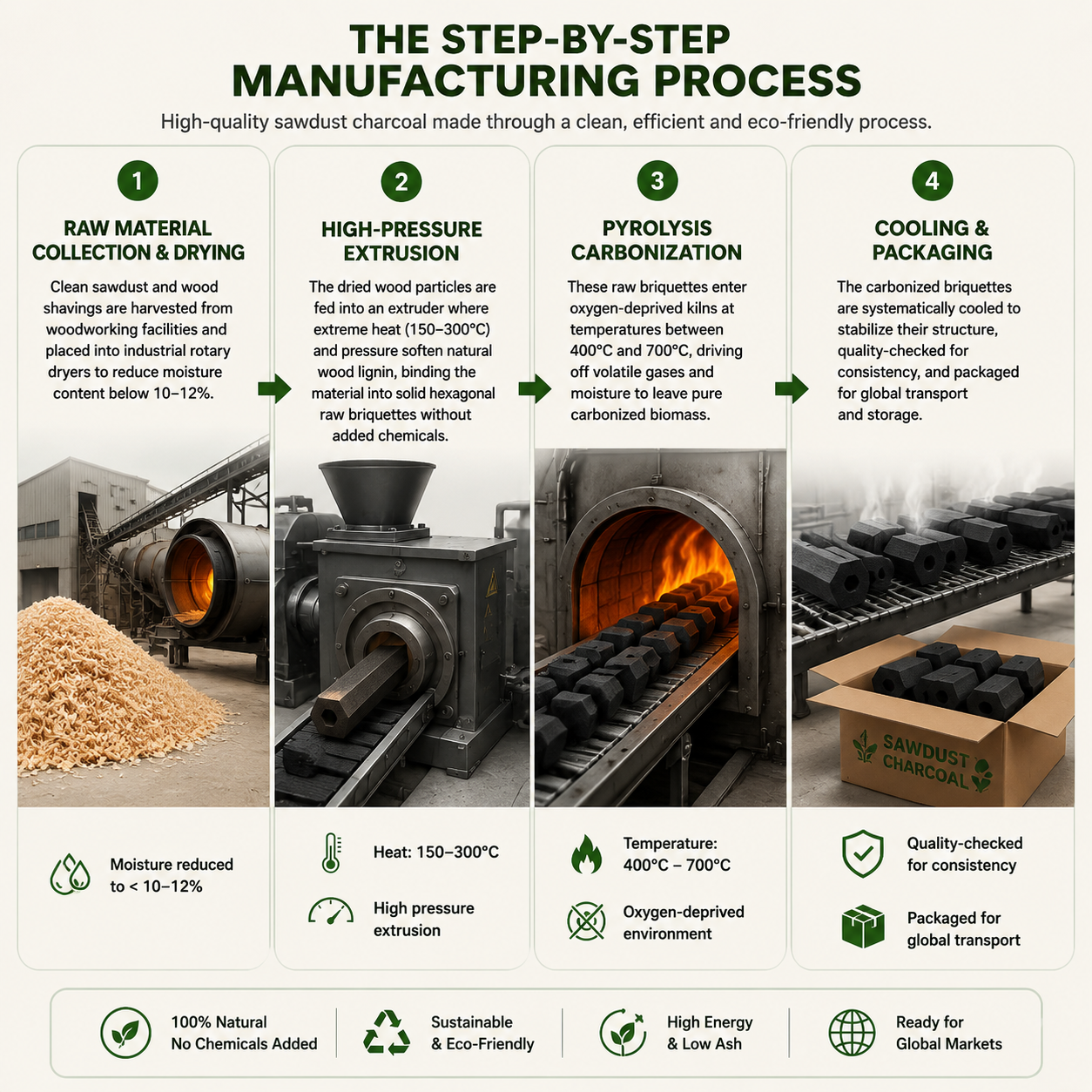
If you are wondering what is sawdust charcoal, its creation holds the answer. The production of high-grade sawdust charcoal involves four streamlined stages designed to maximize quality while minimizing ecological impact:
- Step 1 – Raw Material Collection & Drying: Clean hardwood sawdust is collected from furniture and timber processing facilities and dried to lower moisture below 10%.
- Step 2 – High-Pressure Extrusion: The dried wood particles are extruded under high temperature (150–300°C) and pressure, using natural lignin to form solid hexagonal briquettes without artificial binders.
- Step 3 – Pyrolysis Carbonization: These raw briquettes undergo thermal decomposition in oxygen-deprived kilns (400°C–700°C) to eliminate volatile gases and lock in pure fixed carbon.
- Step 4 – Cooling & Packaging : The carbonized briquettes are systematically cooled to stabilize their structure, quality-checked, and packaged into 10kg–15kg carton boxes for global distribution.
Why Is It Called an Eco Friendly Bio Charcoal?
Understanding what is sawdust charcoal clarifies why it earns its reputation as an eco-friendly bio charcoal, operating on a zero-waste, circular energy model. Repurposing wood leftovers prevents hazardous open-air burning and saves living trees, directly combating global deforestation.
Furthermore, it maintains a carbon-neutral footprint because it only releases the CO₂ that the original trees naturally absorbed. Switching to this sustainable alternative allows users to lower emissions while preserving vital forest ecosystems.
Key Sawdust Charcoal Benefits for Users
Understanding what is sawdust charcoal comes down to its operational advantages. The practical sawdust charcoal benefits make it a standout choice for everyday cooking and high-demand heating. It provides a completely smokeless, odorless, and sparkless burn, ensuring superior air quality and user safety. Its extreme density yields high calorific heat that lasts consistently for 3 to 5 hours, reducing overall fuel consumption and refueling hassles. To top it off, it leaves behind minimal ash residue, making post-combustion cleanup exceptionally quick and effortless..
How and Where Is Sawdust Charcoal Used?
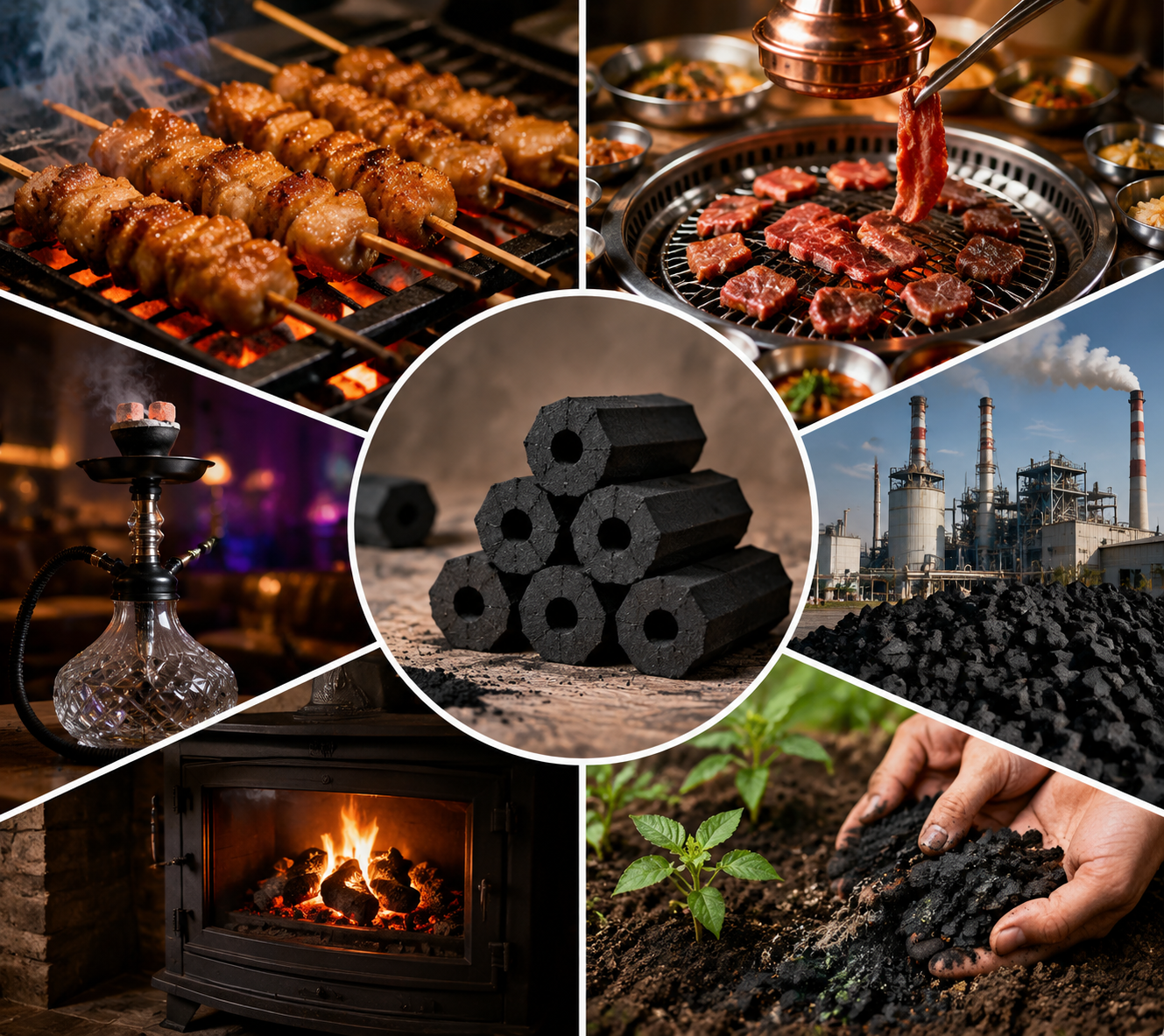
Thanks to its stable heat and clean combustion, sawdust charcoal is heavily favored across multiple global sectors. In hospitality, it powers smokeless Japanese Yakitori, Korean BBQ, and premium Hookah lounges without affecting delicate food or flavor profiles. Beyond culinary uses, it serves as a reliable thermal fuel for industrial boilers, brick kilns, and home fireplaces. As a bonus, leftover ash can even be repurposed as a nutrient-rich soil conditioner for agricultural crops.
Sawdust Charcoal vs. Traditional Fuel Sources
Comparing sawdust charcoal to traditional energy sources highlights its clear superiority in sustainability, heat stability, and overall cost-efficiency across various metrics:
| Comparison Feature | Sawdust Charcoal | Traditional Lump Charcoal | Coconut Shell Charcoal | Fossil Coal |
| Source Material | Recycled Wood Waste | Hardwood Trees | Coconut Shell Waste | Fossilized Carbon |
| Eco-Friendliness | High (Bio-charcoal) | Low (Deforestation risk) | High (Agricultural waste) | Very Low (High emissions) |
| Burn Duration | Long (3–5 hours) | Short (1–2 hours) | Long (3-5 hours) | Extended |
| Smoke & Odor | Smokeless & Odorless | Smoky & Strong Odor | Smokeless & Odorless | Toxic Smoke & Odor |
| Heat Consistency | High & Uniform | Fluctuating | High & Uniform | Extremely High |
| Sparks & Safety | Sparkless | Prone to Popping | Low Sparks | Low to Moderate |
| Ash Content | Low | Moderate to High | Low | High |
Conclusion
In summary, to answer what is sawdust charcoal, it is a modern, high-performance solution that seamlessly bridges the gap between environmental sustainability and thermal efficiency. By transforming timber waste into a long-burning, smokeless bio-charcoal, it offers an unbeatable alternative to traditional fossil fuels and lump charcoal for restaurants, industries, and home users alike.
Partner with Lamian Global to stabilize your fuel costs, elevate food presentation, and streamline container procurement for your restaurant chain. Contact our B2B Export Team today to request factory-direct FOB/CIF pricing, schedule a virtual facility audit, or order a complimentary sample test kit for your culinary team.
- Company: Lamian Global
- Headquarters: 47 Street 36, Van Phuc Residential Area, Hiep Binh Ward, Ho Chi Minh City, Vietnam, 700000
- Hotline / WhatsApp / Commercial Line: +84 812 036 789
- Email: contact.charcoal@lamianglobal.com
- Website: https://lamiancharcoal.com/